
To Willie Bell Gibson, Thanks for Everything!
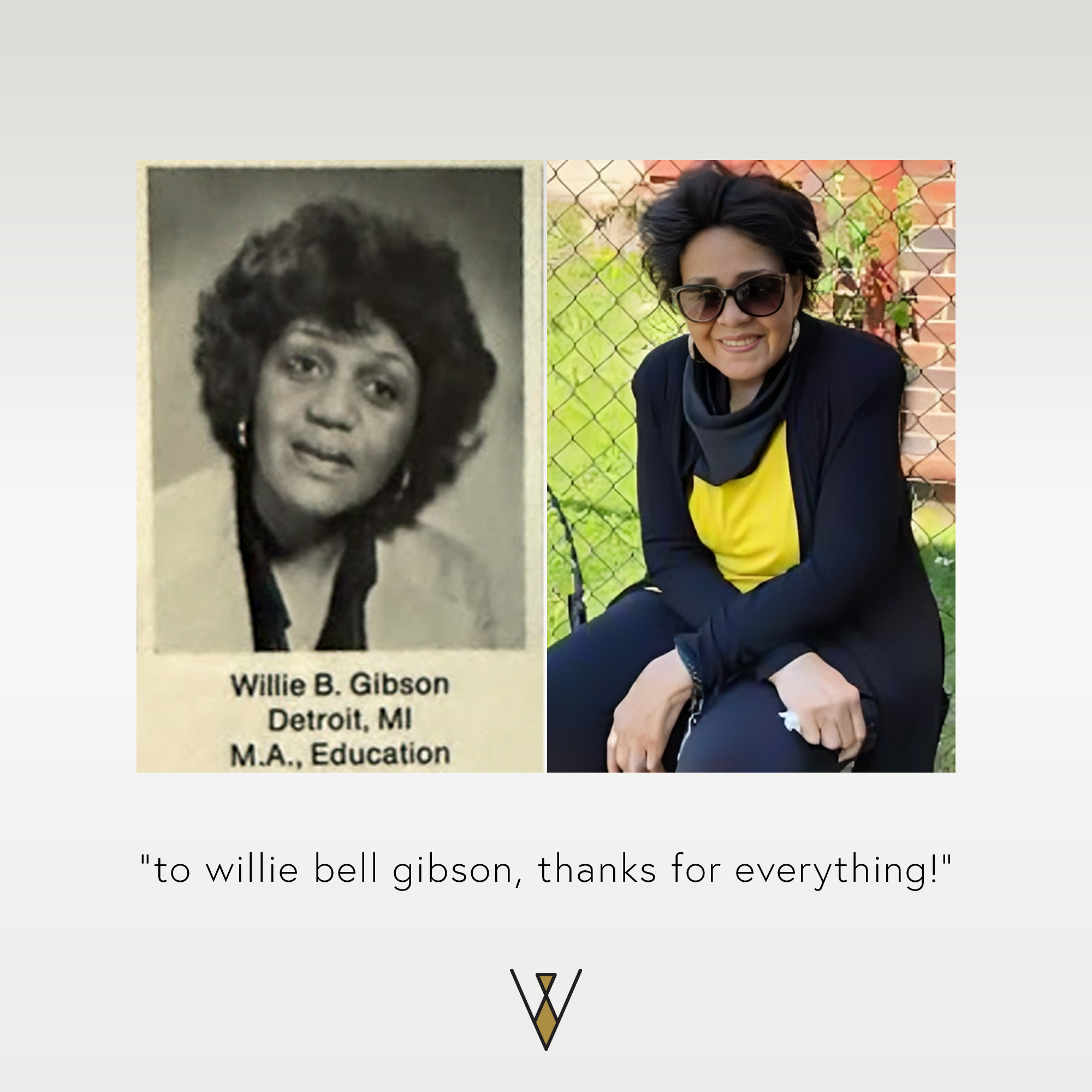
No two days were the same in Willie Bell Gibson’s classroom. Three distinct stories come immediately to mind.
First, she had our eighth grade English class eulogize a fictional dog.
If I remember correctly, we’d read a story about a kid around our age dealing with the death of the family pooch. The narrative itself was sincerely emotional if not actually good, the child’s maturity from toddler to prepubescence to teenagedom identified by their interactions over time with the dog, its overall themes of growth and responsibility and, frankly, grief mirroring many of our personal lives at the time.
Your conventional English teacher might ask for a rote summary of the story, 2 pages, double-spaced. A more enterprising one might ask you to go a bit deeper and develop your own thesis, still 2 pages, double-spaced.
Not Willie Bell Gibson.
She planned a homegoing service.
For a fictional dog!
We each designed a funeral program and prepared an obituary and assigned ceremonial roles to this fictional dog’s fictional friends (think pawbearers, music performances by Snoop Dogg, etc.) and ventured outside to our school playground to perform the fictional rites for the fictional dog’s fictional funeral.
She herself wore black-on-black every single day (It’s much more slimming, I recall her responding in her uniquely dramatic flair to a classmate’s inquiry as to why), but made a one-time exception for the fictional dog’s fictional funeral. That day, she wore all-white.
Do not get me wrong, it was patently absurd in real time, and everybody knew it, most of all Willie Bell Gibson. But it was her commitment to the bit, and her insistence that we too commit, that made the experience of reading that specific story far more enjoyable than it would’ve been in the care of somebody who cared even a half percent less.
For the bulk of us, with high school mere months away, it was an openly childish exercise. And to Mrs. Gibson, I’m near certain that was the point.
Never mistake imagination for immaturity.
Big if true: Most middle school classrooms operate the same way. Hell, most classrooms from pre-kindergarten through graduate school tend to run on one guiding principle, which is the teacher tells the students to do a thing (assignments, errands, sit down and shut up, etc.) and the students, without issue, do said thing.
The student body at the former Alonzo W. Bates Academy for the Gifted and Talented was largely complaisant, and while I will spare you my psychoanalysis for an attempt at brevity, that is to say we mostly did as we were told. At least while we were under adult supervision. I digress.
We were learning structured poetry, specifically limericks. Mrs. Gibson assigned us to write seven limericks on various topics. Now, seven was absolutely a much bigger number than we wanted to hear, but at no point did any of us consider a mutiny. We instead silently groaned in unison and accepted what we believed to be our fate, unaware of the plot twist Willie Bell always kept just around the corner.
“Any questions?” she drolly asked after outlining the assignment.
Silence.
At this point, you could see the mischievous grin forming. “Going twice,” she needled.
Nobody, to her chagrin, would take the bait.
“Come on, people! I’m giving you the opportunity to complain about your homework!” she somehow both bellowed and beckoned to us, many of whom were now too stunned to verbalize any concepts we didn’t think she wouldn’t immediately reject.
“You!” She faux-impatiently pointed at one of my classmates. “Ask me a question! What do you want to change about the assignment?”
“Seven poems seem like a lot, especially with all our other schoolwork,” my classmate sheepishly responded.
To our surprise, Mrs. Gibson agreed. Seven poems became five. We then spent the next 10 minutes negotiating a couple of compromises she accepted (allowing us to select the poems’ subject matter) and others she outright refused (scrapping the assignment altogether). A moment that, in the micro, was about the parameters of our homework, became a larger lesson about the power of self-advocacy.
You never know what you can get unless you ask.
Okay, I fear I’ve buried the lede here.
I’ve spent the first two parts rhapsodizing about the quixotic, fun-loving Willie Bell Gibson, who encouraged her students to question authority and embrace imagination into their adulthood. That’s the woman I came to know exactly twenty (!) years ago now.
But there was a manifest nervousness that permeated every set of rising eighth graders at Bates Academy, especially as it pertained to Mrs. Gibson. None of these stories about her bubbly personality ever trickled down to us in the lower grades. Serious is probably the best descriptor I would’ve given her before actually taking her class. Scary is probably the most paranoid.
To be clear, she was and remains all those things: serious and quixotic, scary and fun-loving, but above all, really gotdamn incredible at her vocation. I am the exact writer I am today because of that woman: my love of compound-complex sentences was forged by her instruction; the semi-colons myriad college professors and work editors have tried but will never remove from my syntax exist as direct homage to her.
I’ve long worried nobody values good writing anymore, and especially with the rise of artificial intelligence, gamifying what can resemble quality feels easier — if not more cunning — than ever before. Willie Bell did not abide cutting corners, and it’s that pride she demanded in both our output and overall character that I’ve strived towards since choosing this craft as my own life’s passion.
Last story.
Our English homework for Black History Month consisted of memorizing and reciting a poem by a Black writer to our classmates. A lot of the boys were being weird about having to perform poetry in front of the girls or something, and I will again spare you the psychoanalysis, but Mrs. Gibson agreed that rap lyrics qualified as poetry and were therefore sufficient, minus expletives, towards completing the assignment.
(Unrelated, but I recited a poem my mother wrote, thinking it would be a layup A. Mrs. Gibson gave me a B! (She said my performance didn’t do the author’s work justice — the author, again, being my mother. What a lady, I swear.))
Despite ample time to prepare, my dearest friend Cedric demurred when Mrs. Gibson announced he was next to perform, maintaining (read: lying) that he hadn’t memorized a poem nor could pull one from memory. Some teachers might’ve scolded him; others may not have cared at all. Willie Bell? She called his bluff.
“I don’t believe there’s nothing you can recite, Cedric,” she said, matter-of-factly. “Because I’m not giving you a zero.”
Their standoff was brief. Cedric relented and trudged slowly towards the chalkboard. His nerves were palpable, but one deep breath later, he delivered a performance I’m not sure Ladies Love Cool James himself could replicate:
When I’m alone in my room, sometimes I stare at the wall
And in the back of my mind, I hear my conscience call
Telling me I need a girl who’s as sweet as a dove
For the first time in my life, I see I need love…
The next 60 seconds were electric. If Ced had chosen music for a career, I’d be pointing to that exact moment as the genesis. It seemed innocent enough then: a teacher refusing to let her student take what appeared to be the path of least resistance when forced outside his comfort zone. Yet what Mrs. Gibson identified wasn’t laziness or stubbornness or even disobedience. There was a belief gap, and she helped close it.
For Cedric, allowing that vulnerability ultimately broadened his perspective. And to Mrs. Gibson, I’m near certain that was the point.
I believe in you. But do you believe in yourself?