The Westbrook Method (Death of a Dynasty III)
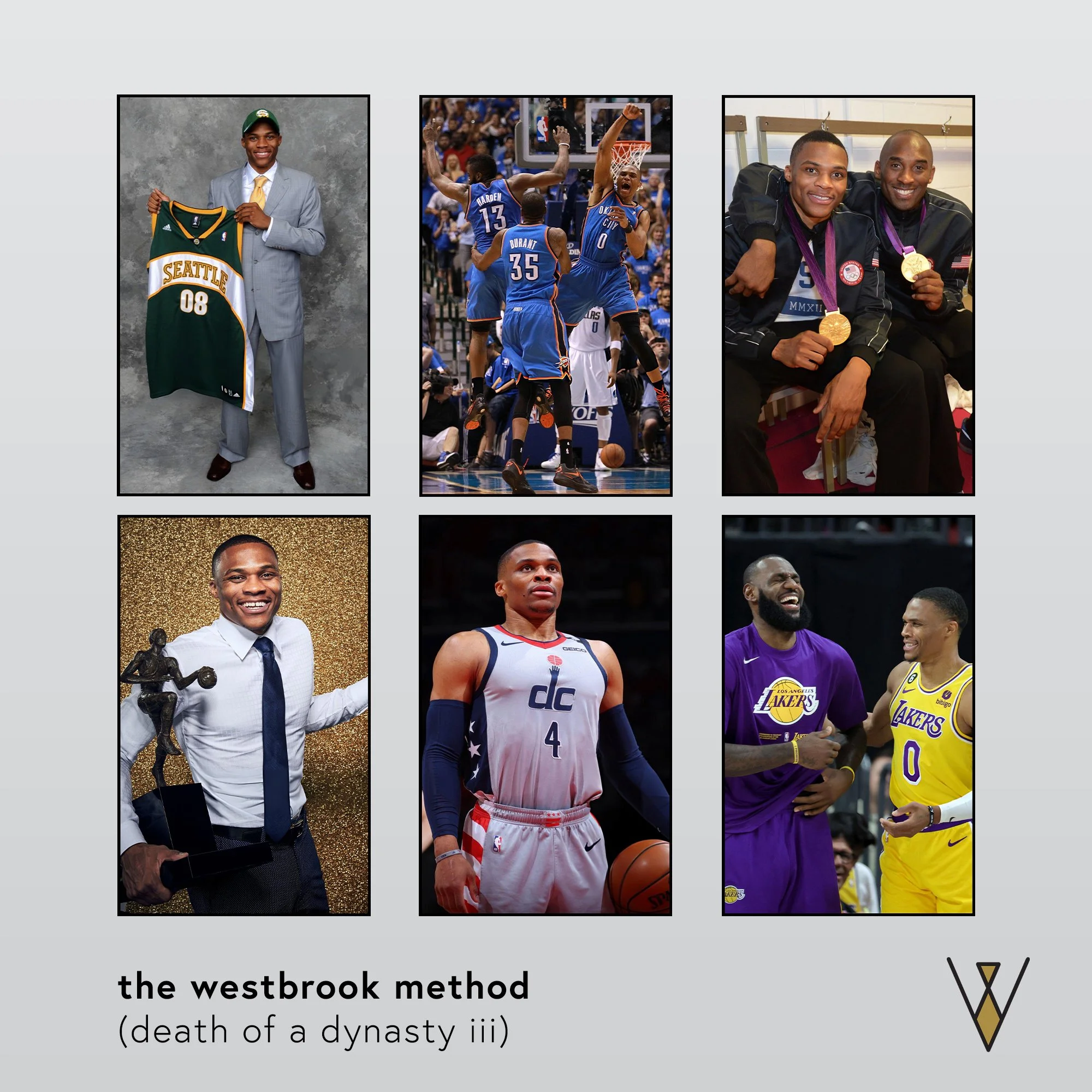
Russell Westbrook played basketball with an almost pathological belief in his ability. It made him MVP, a phenomenon, contradiction — and absolutely impossible to ignore.
As I agonize over this documentary/thesis project/preoccupation currently and actively ruining my mental state, I cannot help but feel compelled to write about one Russell Westbrook, the indomitable force point-guarding what I once expected to be the initial basketball dynasty out of Oklahoma City. There are so many places to start, so many memories I can glean from the deepest depths of my teenage recollections, but it feels most appropriate to begin with the night he clinched his only MVP trophy.
As a capital-J journalist, I take pride in my precision, but the hard facts for this one kinda don’t matter. It was the last week of the 2017 NBA season — one in which he would average the first triple-double the Association had seen in over 50 years, his first as the last of the #ThunderBuddies — and the consensus was that, while his feats were indeed impressive, former teammate James Harden was that year’s Most Valuable Player.
Then Russy went into Denver and lost his absolute mind dog I still don’t know what happened even as I type this nearly a full decade later like this is intentionally a run-on sentence just to convey the literal absurdity of that night:
As if the storyline didn’t need the perfect capper, Russ nails the game-winner. From well beyond the three-point line — approximately 36 feet, according to the statisticians. AND WE ALL KNOW HE CAN’T SHOOT!
Making that jumper was symbolic beyond the victory that night or the absolute hijacking of the MVP trophy that he’d receive a few months down the line. Russell Westbrook has always been much more force of nature than professional basketball player, like if the Looney Tunes’ version of the Tasmanian Devil were six-foot-three with a 40-inch vertical. He attacked the game broadly and the rim very specifically as if he wasn’t cognizant of the possibility — at best, and plausibility, at worst — of maiming himself.
I mean this literally: a teammate once kneed a dent into his head so deep it required surgery; two games later, he did this to a basketball rim:
There was little it seemed the Brodie couldn’t do on the court, if only because he’d take your contention he couldn’t as an affront to his personage. Our insistence he be more circumspect about his supposed limitations only furthered his defiance.
Like the time he scored 43 points against the Heatles in Game 4 of the 2012 NBA Finals exclusively on layups and foul-line middies:
Or the 2019 game versus the Los Angeles Lakers he compiled a box score of 20 points, 21 rebounds, and 20 assists in honor of friend and fellow SoCal native Nipsey Hussle, who had been murdered days before — just the second time in league history that stat line had been recorded:
Or the moment during the 2020 NBA Playoffs he followed a clutch three-pointer with very passionate, if not extremely vulgar, taunting towards an in-person audience of wives, girlfriends, and very small children:
Yet, Russell’s personal determination and self-efficacy could only get him so far. Kevin Durant’s decision to decamp for their direct rival during the 2016 offseason was regarded as a direct referendum on the Westbrook Method. While Russy did win the 2017 NBA MVP, he would never again advance past the first round of the NBA Playoffs with OKC and only saw the second round once more in his career, in 2020 with the Houston Rockets. The smattering of Washington Wizards supporters still in existence hold him in a regard I don’t quite understand, considering the team was an eighth-seeded, first-round near-sweep in 2021, but at least he made the last couple of weeks of April interesting, or something? (In fairness, he did average another triple-double while in D.C. — his fourth in five seasons!)
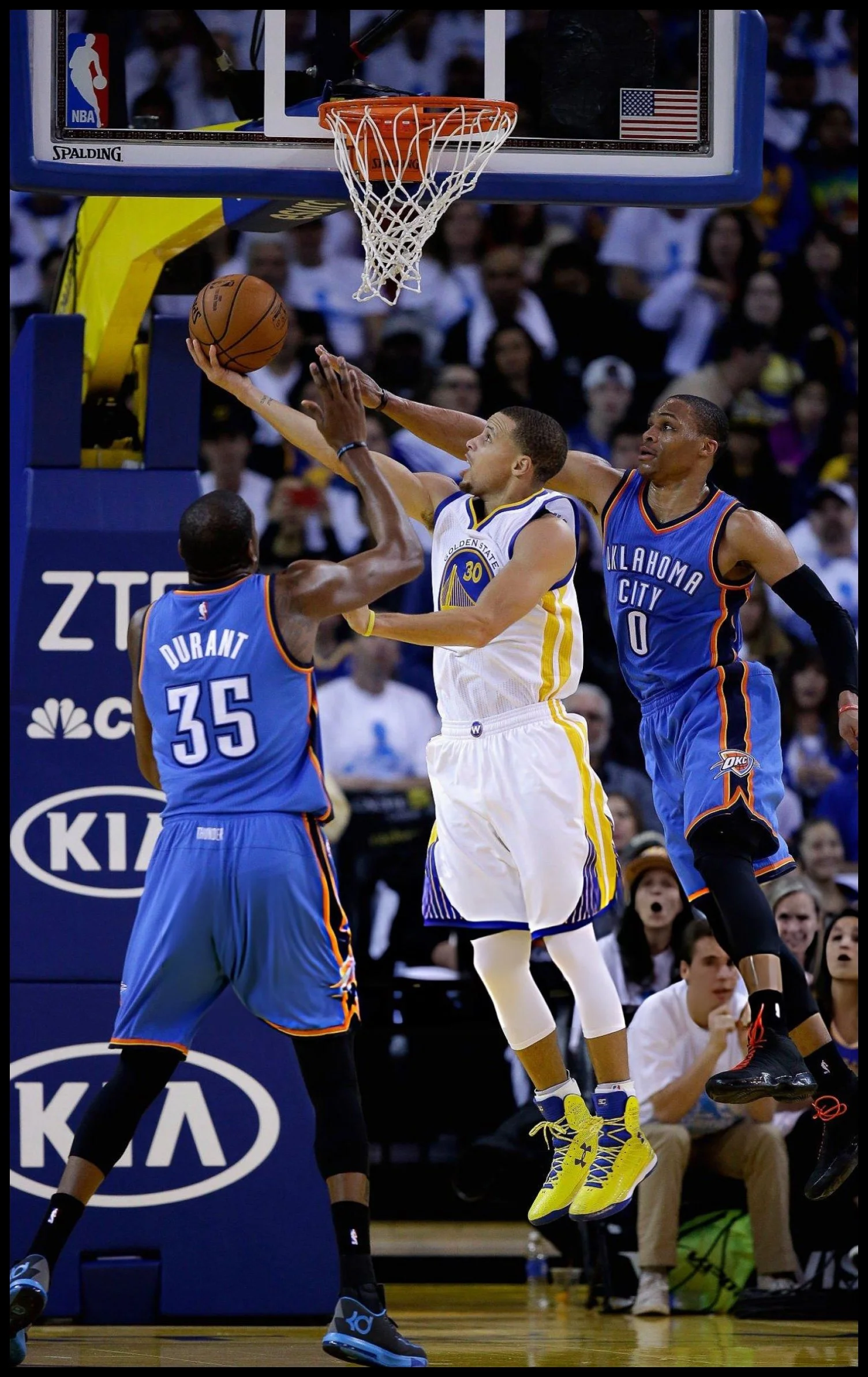
As Golden State became basketball’s new standard — then added Kevin Durant to the equation — Russell Westbrook’s brilliance increasingly came with a question: could the Westbrook Method actually win it all?
Little did we know then that 2021 would be his final year as the lead guard on a pseudo-contender. The LeBron-led Lakers traded for Russy ahead of the next season as their theoretical third option, but their personalities never meshed — let alone their play styles — and they ultimately failed to make the postseason together. A defection to the not-yet-crosstown Clippers in 2023 served as a (spiteful) opportunity to establish that any slippage in his game was at least somewhat overstated, but the move still amounted to minimal success.
Denver offered one last shot at championship glory in 2024 that was scuttled amid an ESPN report of Westbrook-based dissension in the Nuggets’ locker room, and he spent his 18th and terminal season toiling in relative obscurity for the Association’s most futile franchise. The volatility synonymous with his gameplay would also define the end of his career, both for better and worse. Either you die a stalwart or live long enough to see yourself become a journeyman, or whatever Harvey Dent said.
I will readily admit those same traits I regarded as tantalizing at the top of the last decade became causes for personal consternation by the end of it. As Steph, Klay, Dray, and the Warriors commenced their dynasty, running an offense subjectively more dazzling and objectively more victorious by comparison — with his best teammate ever also explicitly choosing to join that Golden State reign instead of building upon their continuity as a duo — debates began to intensify in my own circles and hoops chats everywhere about Russy’s impact on a true winning culture.
To wit: His fans still cannot comprehend serious critiques of an athlete his size regularly accumulating triple-doubles; his detractors remain adamant not only that he was stat-padding, but that it was a team-issued edict! Again, ask any Russ truther about that Wizards season, and they are guaranteed to wax poetic about it, while I’m left questioning whether an unremarkable first-round exit spotlighted by a player they traded mere months later was sincerely worth the trouble.
As with most things Russell Westbrook, I think the answer is more both/and than either/or. The same maniacal competitor thundering (pun intended) at women and kids inside a controlled environment also generously tipped the housekeeping staff upon departing the premises. The same man seemingly impervious to physical pain, let alone verbal insult, also took particular umbrage at what he perceived as wisecracks on his family name. Even while being regarded as the ultimate teammate, his devolution from franchise cornerstone to Sacramento King is somewhat telling, no? As his Nuggets teammates discredited any locker room rancor and vouched for his character, nary a title contender sought his services last offseason, and the offers he reportedly received before announcing his retirement were not from teams topping their conferences. In fact, the Thunder — now once again the perennial threat to win the league championship they were throughout Russy’s prime, and probably his best remaining chance to finally do so — are being lightly roasted on social media for not offering him a farewell tour.
Russell Westbrook’s career was perfectly imperfect. Did he deserve a better ending? Perhaps. But he never rationed himself for the sake of aesthetics, efficiency, or our eventual memories of him. He competed as if every possession were an argument he would win through sheer force of conviction, even and especially when the evidence suggested otherwise. That stubbornness surely cost him, but it also made him a first-ballot Hall of Famer, and for a generation of us, appointment television. That is the Westbrook Method, distilled to its essence: believe in yourself so completely that the line between your greatest strengths and your fatal flaws eventually becomes indiscernible.
There may be cleaner careers or prettier résumés. But there has only ever been one Russell Westbrook, and he never tried to be anybody else.